Introduction
Many manufacturers experience large-scale production problems, like disconnects in the supply chain, varying quality, production delays, and cost overruns. The traditional way of working calls for continuous coordination of several, far-apart suppliers, resulting in high communication costs, info non-transparency, and eventually the longer time resulting in less of a competitive-ness.
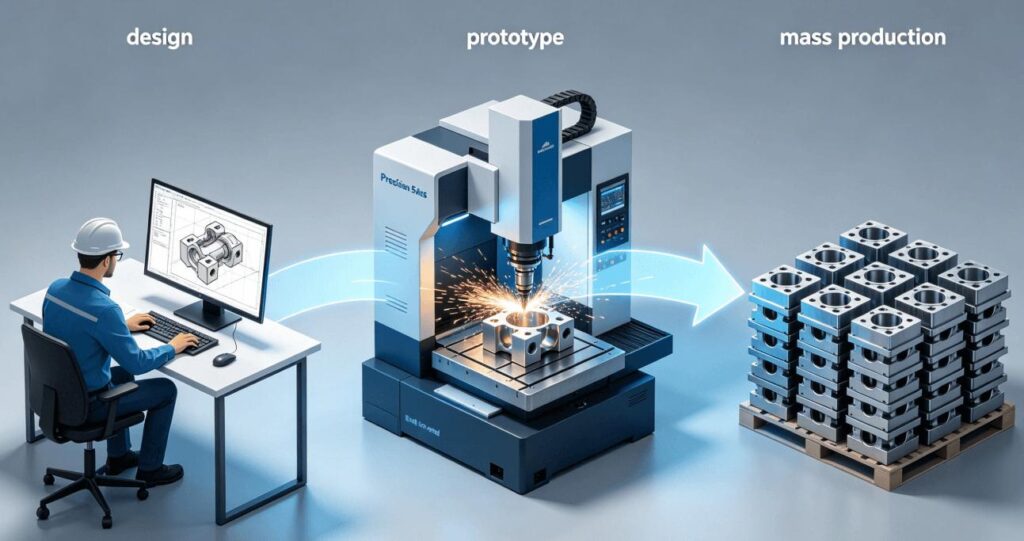
The main reason can be traced to the absence of an integrated, end-to-end partner, who can roll up the entire workflow from design feedback and prototype manufacturing to process validation and batch production. Separate machining services only provide the piece of the puzzle, but do not guarantee the continuity in quality and efficiency from the very first part up to the ten-thousandth.
This paper will discuss the capacity of a one-stop manufacturer with custom CNC milling services to be the solution in surpassing this bottleneck. Through integration of processes, stringent quality control, and dedicated project management, this type of partner really makes a difference for the smoothest transition.
Why are custom CNC milling services the critical bridge between prototype and production?
Supporting Agile Product Development via CNC Milling
Customized CNC milling services are crucial for providing the necessary agility in CNC milling prototyping. As a result, there is rapid manufacturing of functional prototypes that can be used for product design validation and testing.
The End-to-End Partnership Benefits
The core of the benefit comes down to replacing an incomplete chain of suppliers with a complete CNC milling partner that delivers significant competitive advantages compared to other solutions.
- Uninterrupted Process Flow
A partnership with a CNC milling company guarantees continuous information and process flow from your first prototype. As a result, any feedback regarding manufacturability is available during product design, which greatly decreases engineering expenses.
- Systematic Approach to Quality Control
Quality control practices at certified CNC partners are backed up with certification systems, such as ISO 9001 and IATF 16949. Consequently, all processes from prototype manufacturing to production remain under control.
How to ensure absolute stability of CNC machining quality during production ramp-up?
Ensuring stable production quality is the big issue with production ramp-up machining. Consistent production through precision CNC milling services is a guarantee only if the whole strategy is well thought out. The first step towards it is the implementation of Statistical Process Control (SPC) to regularly monitor changes proactively, then getting real-time validation by automated inspection like CMMs, and finally having a quality documentation system that is fully traceable.
The best stability can be achieved via a stringent, end-to-end quality management structure and not just through cutting-edge machinery. Going by the letter of standards like ISO 13485 or AS9100D is what proves such systemic capability. Importantly, such continuous quality is the direct cause of the decrease in scrap and rework which are the major factors in overall production cost control..
How to systematically analyze and optimize the overall cost of a CNC milling project?
A cost strategic assessment of CNC milling prototype Yes takes much more than the unit price quote. The real overall cost includes several elements: raw material costs, machine programming and runtime, setup charges, tooling wear, quality inspection and risks of delays that are intangible and So difficult to quantify. The use of strategic methods is indispensable if one strives to optimize these costs in a systematic way. The early integration of Design for Manufacturability (DFM) is a good way to reduce the machining time and difficulty by making the part geometry less complex.
Suppliers should be informed about the budget targets in a clear and open manner so that the process optimization can be carried out together. Besides, Consider realize that the one-time expenditures, like fixtures or tooling alterations, can be regarded as the major factors for the reduction of the per-part cost of goods in the long production runs. A manufacturing partner that is exemplary will release cost breakdowns without any reservations and work closely with the client to find the most efficient and economical solution.
What core capabilities should you focus on when evaluating a CNC milling service partner?

Core Competencies: Technical and Quality Foundations
The choice of a machining supplier should necessarily start with a thorough evaluation of their capabilities. Important criteria to consider when evaluating potential suppliers include Technical Capability, which should focus on the capabilities of their machine park (e.g., 5-axis machines), their work envelope, the materials they specialize in, and their finishing capability.
Proven Experience and Operational Reliability
But it does not end there, since other factors that may not always be related to the actual machines used but rather to the reputation and reliability of the company itself should also be considered. These include Industry Experience & Case Studies and, most importantly, reliable references that demonstrate experience in the relevant industries (e.g., aerospace and medical devices).
- Scalability: Capacity and Supply Chain
Determining Scalabilitynecessitates ensuring that the vendor has the capability to produce according to the current and future volume requirements without any compromise to time and quality.
- Reliability: Stability and Security
Determining Reliabilityentails reviewing their stability in the supply chain in regard to material sourcing, as well as their NDA policy to guarantee maximum security of your intellectual property..
What are the special considerations for selecting a service provider for large or complex part projects?
Projects which involve machining in relation to large dimensions, intricate geometries, exotic materials, or tight tolerances bring many difficulties in addition to those associated with normal machining operations. Among the key concerns which should be taken into account by any supplier will be the capacity of the machine tool itself in terms of the machine work envelop, as well as the level of precision at which it can hold a position throughout the work envelope. In addition to this, the expertise in relation to advanced programming, multi-axis machining operations, and machining techniques for exotic materials will also need to be considered. Inspection solutions for large parts will also become very important. This requires an experienced partner when it comes to large CNC milling services.
Conclusion
Therefore, one of the most important considerations when it comes to transitioning from rapid prototype development to full-fledged mass production is finding an end-to-end manufacturing partner. An end-to-end manufacturing partner, like LS Manufacturing, offers much more than just custom CNC milling; their services include design assistance, quality control, and project management.
When looking for a dependable and efficient manufacturer to work on your part project throughout its lifetime, it makes sense to assess their end-to-end capabilities first and foremost. In this case, the best place to start would be an initial engineering consultation.
Author Bio
Jane is an industry guest columnist with over a decade of experience in advanced manufacturing and supply chain management. Jane focuses primarily on CNC machining technology and digital manufacturing, aiming to bring insightful information to industry decision makers.
FAQs
Q: Will there be any differences in terms of quality between the prototype CNC milled and the production piece?
A:The end-to-end professional service provider will ensure that the prototype will be as similar to the product as possible regarding dimensions, materials, and functionality because of using the same processes and quality controls since the prototyping stage, providing the design validity.
Q: How long does it typically take from CAD file reception until first prototype arrival?
A:Time frame largely depends on the part complexity and available materials but the average time required to produce the standard CNC milled prototyping project is 1-3 weeks. Also, fast prototyping services usually are available taking only days.
Q: How are the quality characteristics controlled and what are the control methods used in production ramp-up?
A:Trusted providers use Statistical Process Control (SPC) when ramping up part production machining, performing automatic inspection to collect and analyze trends in relation to control limits.
Q: What does it mean if a CNC milling service provider is certified by both ISO 9001 and IATF 16949?
A: ISO 9001 is a worldwide quality management system to ensure the stability of processes. While IATF 16949 focuses on defects and waste prevention in the automotive sector. Both certifications prove that you have a mature quality management system.
Q: When looking for a CNC milling provider, what are the three most critical criteria for evaluation?
A: The three most critical criteria are: 1) Technical expertise and machinery as the basis, 2) Mature quality management system and related certifications as the guarantee, and 3) Success stories and experience in the same industry projects as the soft skill key to avoid risks. They are all necessary.