The 2026 Connectivity Revolution: How the World Just Got a “Super-Brain”
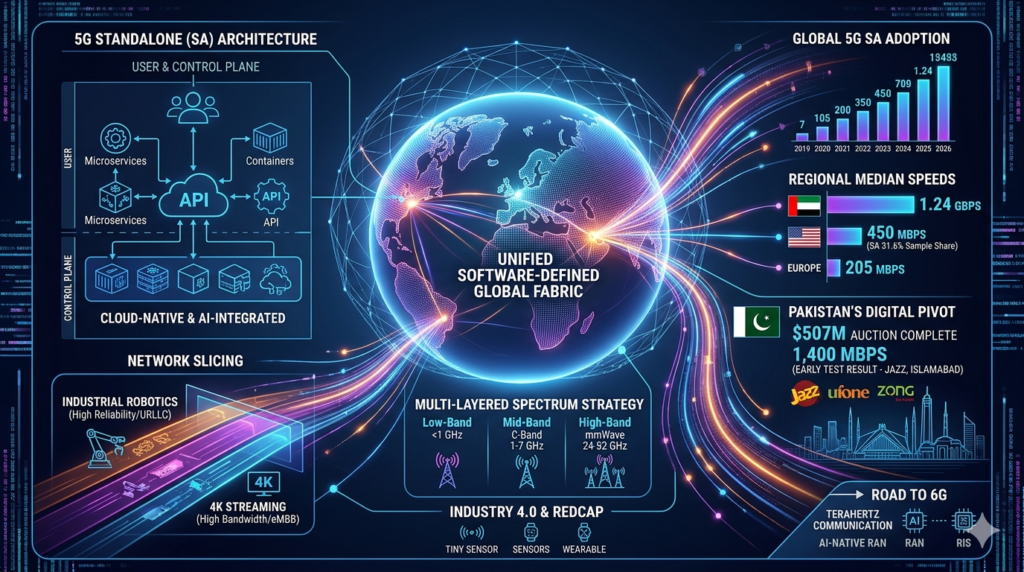
Imagine if every device on Earth—from the smallest watch to the biggest factory robot—could talk to each other instantly, without ever lagging or dropping a connection.
In 2026, this isn’t science fiction anymore. It’s the 5G Revolution. We’ve moved past just having “fast internet” for YouTube; we’ve built a giant, invisible “software brain” that runs our whole world.
1. The “Brain” Upgrade: 5G Standalone (SA)
In the beginning, 5G was like a fast engine inside an old car. In 2026, we finally built the whole car from scratch. This is called 5G Standalone (SA).
- Cloud-Native: Instead of relying on old wires and heavy boxes, the network now lives in the “Cloud.” It’s all software, which makes it incredibly fast and smart.
- Network Slicing (The Special Lanes): Imagine a massive highway. With 5G SA, we can “slice” the highway into private lanes:
- The Hero Lane: A super-reliable lane for emergency robots or remote surgery.
- The Movie Lane: A wide lane for people watching 4K videos.
- The Gadget Lane: A lane for millions of tiny sensors in a “Smart City.”
2. Spatial Intelligence: How the Signal Reaches You
To make the internet 100 times better than 4G, 5G uses three different “flavors” of airwaves:
| Type | What it Does | Best For… |
| Low-Band | Travels very far and through walls. | Rural areas and inside buildings. |
| Mid-Band | The “Sweet Spot.” Fast and covers a good distance. | Cities and suburbs. |
| High-Band (mmWave) | Super-fast (Multi-Gigabit!) but short-range. | Busy stadiums and downtown hubs. |
The Magic Trick: 5G towers now use Massive MIMO (hundreds of tiny antennas) and Beamforming. Instead of spraying a signal everywhere, the tower “shines” a laser-focused beam of data directly at your phone!

3. The Global Leaderboard: Who’s Winning?
The race is no longer about who has the most towers, but who has the smartest network.
- The Middle East (UAE): The world champions! Their 5G is 5 times faster than Europe’s.
- North America: The U.S. is leading in “Business 5G.” Companies like T-Mobile are even using Starlink satellites to make sure you have a signal in the middle of the ocean or a desert.
- Europe: They are spending billions right now to catch up and upgrade their “brains” to the newest 5G version.
🇵🇰 Spotlight: Pakistan’s Digital Big Bang
On March 10, 2026, Pakistan changed its future. The government sold “airwave space” to companies like Jazz, Zong, and Ufone for $507 million.
- The Result: In early tests in Islamabad, speeds hit 1,400 Mbps!
- The Impact: This helps Pakistan sell more software and IT services to the rest of the world, bringing billions of dollars into the country.
4. Robots, Wearables, and “RedCap”
5G isn’t just for phones. It’s the backbone of Industry 4.0 (Smart Factories).
- RedCap (Reduced Capacity): This is a new “Light” version of 5G. It’s perfect for things that don’t need to be super-fast but need to stay connected for a long time—like your smartwatch or industrial sensors that tell a factory when a machine is about to break.
5. Staying Safe in a Connected World
Since everything is connected, hackers have more doors to knock on. In 2026, we use “Zero Trust” security.
The Rule: The network doesn’t trust anyone. It asks for “ID” every single time a piece of data tries to move, ensuring that a hacker in a “Movie Lane” can’t jump over to a “Hospital Lane.”
6. The Future: Is 6G Next?
Even though 5G is now “mature,” scientists are already dreaming of 6G.
- AI-Native: Networks that fix themselves using Artificial Intelligence.
- Holograms: Using “Terahertz” waves to send 3D images of people so you can “see” them in your room.
- Smart Surfaces: Using special walls (RIS) that can actually “bounce” signals around corners so you never lose your connection.
Conclusion
In 2026, 5G is the invisible force that keeps our world running—from saving lives in hospitals to helping farmers grow more food. It is the foundation of our new digital economy.