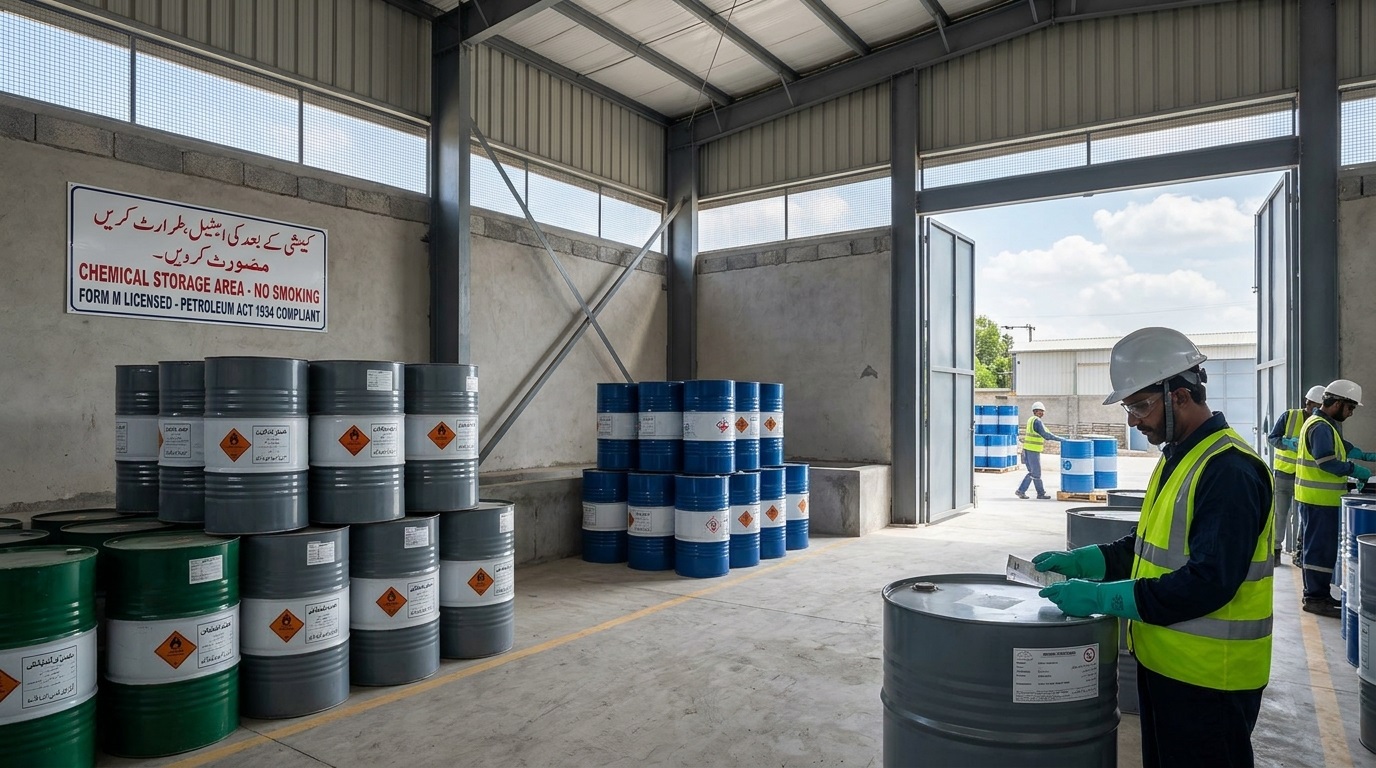
Every business that handles solvents, paints, lubricants or other petroleum products eventually faces the same question: build a licensed godown, or rent space in one that is already approved? The right answer depends on your volume, your timeline and how long you plan to stay in one location. Here is how to weigh it up.
Why a normal warehouse will not do
Any liquid with a flash point below 93°C counts as petroleum under Pakistani law. It may only be stored in premises licensed by the Department of Explosives. A licensed godown has to meet specific building rules:
- block walls and RCC columns, with no wood in the structure
- a sump floor about 2 ft deep, so a leak stays inside
- wire-gauze ventilators and outward-opening steel doors
- fire-fighting equipment and a guard
- open space around the building for the safety distance
A standard warehouse almost never has these, so “just renting a warehouse” is not an option. The real choice is between building a compliant godown and renting one that is already compliant.
Location matters as much as the building
Before comparing costs, look at where the storage will be. The safety distance grows with the quantity you store. For Class A petroleum it starts at 9 metres for 25,000 to 50,000 litres and rises to 15 metres above 100,000 litres. A godown squeezed between houses or shops cannot meet that, however well it is built.
Industrial areas with wide plots and good road access are the safest bet. They also make life easier for the tankers and trucks that deliver and collect your stock, and for the fire brigade if it is ever needed.
The case for building your own
Building makes sense when:
- You need large or growing capacity. A 30 × 30 ft godown with a 2 ft sump can be licensed for about 48,410 litres. Bigger operations may need several godowns or bulk tanks under a Form L licence.
- You will stay in one place for many years. The plot, the construction and the NOCs are a long-term investment that pays back over time.
- You want full control over layout, access and security.
The costs to plan for:
- Land: a plot of about 120 × 120 ft is the practical minimum for a 30 × 30 ft godown with clearance on every side.
- Construction to the approved plan.
- Government fees: Rs 25,000 for Form M.
- NOCs from six departments: Deputy Commissioner, municipal office, Civil Defence, Anti-Narcotics Force, EPA and police.
The biggest cost is often time. From buying land to holding the licence usually takes several months.
The case for renting
Renting makes sense when:
- You need to start quickly. A godown already built to the rules can be licensed in your name without waiting for construction.
- Your volumes are modest or seasonal. You pay for the space you use, not for land you may not need next year.
- You are testing a new city or market before committing capital there.
- You want to avoid construction risk. Building a godown that later fails inspection is the most expensive mistake in this process.
Questions to ask before you sign a lease
- Does the building match the rules? Ask to see the sump, the ventilators and the doors. Your licence application depends on them.
- Are the landlord’s papers in order? The tenancy agreement and the ownership documents go into your licence file.
- Who provides the guard and the fire equipment? These are licence conditions, so put the answer in writing.
- What capacity does the godown support? It sets the quantity you can declare.
- Can you stay long enough? Moving means re-licensing at the new site, so a short lease can cost more than it saves.
Costs people forget
Whichever route you take, budget for more than the rent or the construction:
- The annual renewal challan. It is due by 1 December, and late submission can double it.
- Fire safety upkeep: extinguisher refills and sand.
- The guard’s salary.
- Amendment fees if you add new chemicals or capacity later.
These running costs are the same whether you rent or build, so include them in both sides of your comparison.
Two examples
A paint distributor with seasonal stock. A trader who keeps about 20,000 litres of thinners and solvents for the busy construction months does not need a plot of their own. Renting a compliant godown lets them get licensed quickly, scale down in the quiet season, and avoid tying up money in land and construction.
A manufacturer with steady demand. A factory that uses around 45,000 litres of solvents every month, year after year, is in a different position. Rent paid over ten years can easily exceed the cost of building. A 30 × 30 ft godown on a 120 × 120 ft plot covers that volume, can be licensed for about 48,410 litres, and becomes an asset the business owns.
Most businesses sit somewhere between these two. The questions are the same: how much do you store, how long will you stay, and how soon do you need to start?
What happens if you move
A storage licence belongs to a specific site, not to your company in general. If you move to a new godown, the new premises need their own inspection, NOCs and licence. Plan the move early, and keep the old licence valid until the new one is issued, so you are never storing stock without cover.
A simple way to decide
| Your situation | Better choice |
|---|---|
| Need storage within weeks | Rent |
| Small or uncertain volumes | Rent |
| Large, steady volumes for many years | Build |
| Bulk tank storage (Form L) | Build |
| Expanding to a new city | Rent first, build later |
Many businesses do both. They rent while their own site is being built and licensed, so trading never stops.
To compare the numbers for your own case, a free DPL cost estimator gives a quick breakdown of the government fees and NOC costs for each type of storage.
About the author: Tariq Hussain Malik is the founder of Excellent Services, Karachi, which designs, builds and licenses petroleum and chemical storage across Pakistan and also offers DPL-ready rental godowns. The firm has worked in petroleum licensing since 1999.